Frequently Asked Questions about Nargesa Laser Welders
What exactly is the Laser Welding Equipment MS20 and what is it used for?
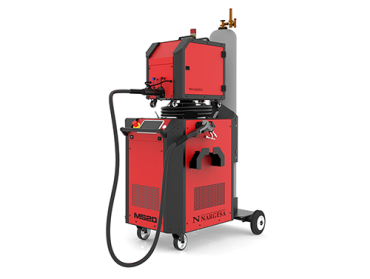
The Laser Welding Equipment MS20 is a 2000 W fiber laser welding system (Class 4), designed for welding sheets of different materials, thicknesses and positions, with integrated modes for weld seam cleaning and sheet cutting.
What power, power supply and control does it include
Power: 2000 W, 220–240 V single-phase, water cooling, and a 7" ESA S820 touchscreen with a program database (welding/cleaning/cutting) and alarm diagnostics.
It is equipped with two dual-drive motors for wire feeding from 0.8 to 2 mm. This means you can weld with two wires simultaneously up to 2 mm, or have one wire of each material to avoid time-consuming material changes.
What “3-in-1” functions does it include
In addition to welding a wide range of materials such as steels, aluminum and even titanium, it allows you to clean weld seams without changing accessories and to cut carbon steel up to 10 mm thick.
What materials can I weld
The maximum fusion depth offered by the Laser Welding Equipment MS20 is 6 mm in carbon steel, aluminum and stainless steel.
You can also weld titanium, copper, gold, platinum, cobalt and many other materials. This makes it the ideal welder for a wide variety of sectors: automotive and auxiliary industries, metalworking, boiler-making and light-structure workshops, machinery and equipment manufacturers, aerospace, railway, electronics, instrumentation, metal furniture, decoration, repair shops, prototyping, and more.
What thicknesses can a 2000 W handheld laser welder work with?
The maximum thickness of the material to be welded depends on the type of material selected, its alloy, the weld geometry and the gap between the parts to be welded. As a general market reference, practical limits on handheld machines are defined by the combination of power/material/technique (oscillation, wire feed, focus).
We recommend demos/tests on your own parts to validate penetration and appearance within your working range. Practically full penetration can be achieved on 6 mm carbon steel sheet.
Can the Laser Welding Equipment MS20 weld with filler wire?
Yes. Not only can it weld with filler wire, but the feeder has two motors, each with 4 powered rollers, and supports two 15 kg spools (up to Ø 2 mm), allowing you to work with two wires (same or different material) without mechanical changes. This enables welds with twice the filler material and provides much higher productivity when changing material.
Is the wire feeder fixed?
No. It is removable, providing an additional 3.5 meters of reach at the welding head, which is very useful for large or hard-to-reach workpieces. Unlike other brands, we have grouped all hoses, cables and filler wires into a single harness, making work much more comfortable and efficient.
What shielding gases can be used?
The equipment includes a holder for Argon, Nitrogen and Ar/CO₂ cylinders, as well as a connection for a 0–10 bar regulator; the choice of gas depends on the material.
N₂ (Nitrogen) is the best choice for welding steel and stainless steel. Ar (Argon) is used for welding aluminum and reducing porosity in weld beads. We provide tailored advice for each specific use case.
How do I select the nozzle and wire diameter?
They are selected according to the type of joint, thickness and amount of filler required:
-
A single nozzle for precision on thin sheet metal.
-
A double nozzle when more filler wire is needed (T-joints, lap joints, greater thicknesses).
Once you have chosen the nozzle type (single or double), you then select the appropriate model for the filler wire diameter you want to use.
All nozzles are marked with two letters and two numbers:
Letters A, B, AS, BS and DS indicate nozzles suitable for flat, internal and external welds.
Letters C, CS, ES and FS indicate nozzles suitable for external welds.
Letters CT indicate a cutting nozzle.
For example, we would use the CS-12 nozzle to make external welds with 1.2 mm wire.
What control do I have over the parameters?
You can use presets (predefined settings) by material type and thickness. These settings are configured and tested at the factory for each material and thickness to ensure strong and visually appealing welds.
Each customer can modify these factory parameters according to their needs and save them in the library for future use. The operator can store up to 10,000 programs in the ESA interface.
Does it clean the weld seam? What range does it cover?
Yes. The cleaning mode allows you to clean up to 5 mm with a single nozzle, up to 8 mm with a double nozzle and up to 18 mm with the specific cleaning nozzle.
Can I cut with the Laser Welding Equipment MS20?
Yes. It can cut carbon steel up to 10 mm (fine cutting for trimming and adjustments).
What is included as standard?
A complete kit of nozzles and tips (single and double), focusing lens + 10 protective lenses, drive rollers (V-groove for steel wires and U-groove for aluminum wires) for different diameters, cutting nozzle and tip, cleaning nozzle, wire liners, magnetic support, certified safety glasses, triple Allen key, Phillips screwdriver, 17–21 wrench, adapter from double to single nozzle, and centering tape.
What maintenance is required?
Periodic checks of the chiller such as coolant level, inspection of optics, inspection for spatter on nozzles and tips, wear of roller guides and drive units, gas level and filter cleaning; the interface provides preventive maintenance alerts.
It includes a corrective maintenance guide and step-by-step instructions for replacing lenses and wire.
As daily maintenance, you only need to check that the protective lens is in good condition (this inspection takes about one minute) and perform a visual check of the alignment of the laser beam relative to the filler wire.
How is the laser focus adjusted and why is it important?
Adjusting the focus calibrates the point where the laser concentrates its maximum energy. Correct focus ensures good penetration, clean cuts and narrow, well-defined weld beads. If the focus is too high or too low, the energy is dispersed and problems arise such as burrs, lack of fusion or cold welds.
To adjust the laser focus:
-
Place an aluminum plate (approx. 3 mm) on the table, clean the work area and put on your safety glasses.
-
From the machine control, open the focal point adjustment menu.
-
Rest the nozzle on the plate at an angle of about 45° and make an initial test shot.
-
Then slightly loosen the nozzle holder nut and move it in small steps (approx. 1 mm, normally in the negative direction), making one shot at each position.
-
The correct position is the one where you see the greatest number of sparks, longer and more abundant. Once you find it, retighten the nut to lock the holder and set that position as the working focus.
What safety measures must I comply with?
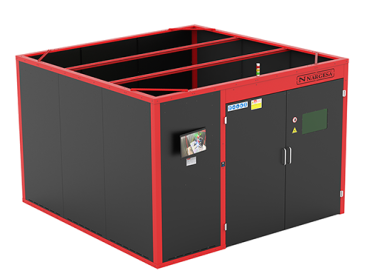
It is a Class 4 laser (1080 nm). It must be operated inside an enclosure/cabinet in accordance with ISO/IEC 60825-1 and ISO/IEC 60825-4, with interlocks, appropriate signage and PPE (certified safety glasses).
Sector note: when working outside closed cells, certified booths/curtains are used to reduce the operational risk to “Class 1”.
What typical faults can the machine warn me about?
Alarms for gas pressure, low chiller coolant level, temperature alerts for the lenses in the head, resonator, PLC, etc., with on-screen descriptions and suggested actions detailed in the instruction manual, in the error management table.
How can porosity or spatter be avoided?
To avoid porosity and spatter in the weld, it is essential to ensure proper gas shielding and that the nozzle and optics are in good condition.
Spatter usually appears when the optics or nozzle are dirty or damaged, or when gas flow is insufficient or excessive: clean or replace the lenses and nozzle and gradually increase the gas flow until the weld pool stabilizes.
Porosity is usually due to poor gas shielding, contamination on the workpiece, or unsuitable gas:
-
Use high-purity gas (99.99%) with a stable flow rate appropriate to the thickness.
-
Keep the nozzle clean or replace it with a new one.
-
Clean the material thoroughly before welding (degrease with a solvent such as acetone and use a wire brush to remove oils, oxides and dirt).
What are its dimensions and weight? Is it mobile?
The Laser Welding Equipment MS20 has dimensions of 722 × 1200 × 1736 mm and weighs 264 kg. It is equipped with wheels on the machine and on the feeder, and has an integrated gas bottle holder for safe and easy mobility..
What warranty and support does it offer?
As manufacturers, we offer a 2-year warranty with registration (1 year without registration) and fast, free and unlimited technical support for the entire range of machinery.
Most incidents are resolved remotely and in less than 24 hours.
Are there any installation/environment requirements?
Keep the temperature between 0°C and 30°C and relative humidity between 30% and 80%, in a clean area free from vibrations. Fume extraction must be integrated if regulations require the cell to have an upper enclosure.
The equipment cannot be used on the same table as a TIG welding machine.
What differentiates the Laser Welding Equipment MS20 from others
Dual drive with 8 powered rollers (4 rollers per motor), integrated supports for two 15 kg spools, removable feeder, single harness for all hoses and cables, Industry 4.0 technology (remote assistance/alerts), integrated drawer for tool storage, 6 mm fusion depth in steel, stainless and aluminum, and gas support integrated into the chassis.
The Laser Welding Equipment MS20 is not just a laser welder: it is a safe and cost-effective industrial laser welding system, specifically designed for metalworking shops that want to produce more, with a better finish and lower risk.
How are the laser cell safety systems connected to the MS20 safety systems
Because NARGESA manufactures the Laser Welding Equipment MS20, we can adapt any safety system of any cell to the equipment. In this way, if an emergency requires opening the cell safety enclosure, the MS20 will shut down automatically in a safe manner, in compliance with all safety standards.
Can laser welding be automated using robots? With which robots?
Yes, it can be automated. In fact, NARGESA offers a laser welding solution with a cobot by integrating the Laser Welding Equipment MS20 with Universal Robots, further increasing productivity and improving the precision and speed of laser welding.
The cobot features an application developed specifically to program the robot very quickly and intuitively, using multiple explanatory pictograms.
If you wish to integrate the Laser Welding Equipment MS20 yourself with a robot from another manufacturer, please contact NARGESA and we will provide all the necessary information.
I need the complete project: Welder + Robot + Cell + Table, fully compliant with European regulations. Can NARGESA do it?
Yes, we can. At NARGESA we not only supply the Laser Welding Equipment MS20, but we also design and execute the entire turnkey project: Laser Welding Equipment MS20 integrated with a Universal Robots cobot, certified welding cell and Siegmund welding table.
We configure a custom, fully integrated, ready-to-run solution that complies with all applicable European safety regulations for the installation, from the initial study through commissioning and operator training.