What operations does a vertical broaching machine allow?
A vertical broaching machine allows high-precision machining using a tool called a broach, which progressively cuts the material as it moves in a straight line. This process is ideal for achieving complex and repetitive shapes in metal or plastic parts.
Among the most common operations:
- Internal keyway broaching: one of the most frequent applications, especially for gears and couplings, on both metal and plastic parts. Allows for highly precise keyway seats, essential for transmitting torque on shafts.
- Internal broaching of special profiles: such as splines, squares, hexagons, or custom geometries within pre-drilled holes.
- Flat surface finishing: allows machining of flat faces or surfaces with precise tolerances.
- Series reproduction of complex shapes: with high repeatability and excellent surface quality.
Thanks to its precision and productivity, the vertical broaching machine is widely used in the automotive, industrial machinery, aerospace sectors, and in the production of molds and technical components.
What is the difference between broaching and slotting?
Although broaching and slotting may seem similar since both are used to generate internal or external shapes in mechanical parts, there are important differences in technique, tool, and final result.
Broaching:
- Method: Performed with a tool called a broach, which has a series of progressive teeth that cut the material in one or several passes (vertical or horizontal).
- Movement: Continuous linear movement in a single direction.
- Machine type: Broaching machine (vertical or horizontal).
- Common applications:
- Keyways.
- Internal and external splines.
- Special profiles (squares, hexagons, etc.).
- Advantages:
- High precision and repeatability.
- Ideal for series production.
- Unique parts.
- Excellent surface finish.
Slotting:
- Method: Involves manually or mechanically machining a groove or cavity in a part, generally to keyways or for mechanical assembly.
- Movement: Can be manual (file, saw, chisel) or using machines such as milling machines, mortisers, or presses.
- Tool type: Variable (cutter, punch, chisel, etc.).
- Common applications:
- Preparing keyway seats.
- Mechanical joints in metalworking or cabinetry.
- Advantages:
- Does not require as specialized tools as a broach.
- Limitations:
- Less precise than broaching
- Slower and dependent on the operator or method used.
What types of metals can be machined with these machines?
Broaching machines can machine a wide variety of metals and plastics, the most common being:
- Carbon steels
- Alloy steels
- Stainless steels (under certain conditions)
- Aluminum
- Brass and copper
- Bronze
- Technical plastics (such as nylon, polyamides, industrial PVC, etc.)
Important consideration: material hardness
When working with metallic materials, it is essential to consider their hardness. For example:
- Common steels can be machined with conventional broaches made of high-speed steel (HSS).
- For stainless steels or other more abrasive materials, titanium-coated broaches (TiN) are required, providing greater resistance to wear and heat generated during the process.
- Using conventional broaches on hard materials like stainless steel will lead to premature wear and suboptimal finish.
Machining plastic materials is generally simpler.
What dimensional accuracy can be achieved?
Nargesa broaching machines, especially in well-calibrated applications with tools in good condition, can achieve extremely high dimensional accuracy. Under normal working conditions, tolerances of up to:
- ±0.01 mm on internal profiles such as keyways, splines, or hexagons.
- Excellent repeatability in series production, even with long continuous cycles.
- High-quality surface finish, with roughness in the range of Ra 0.8–1.6 μm, depending on the material and broach type used.
This accuracy is possible thanks to:
- The progressive and constant advance of the broach teeth.
- The rigidity of the broaching machines.
- The quality and sharpness of the tool.
What types of broaches or tools are used?
Broaching machines use a specialized tool called a broach, consisting of a series of stepped cutting teeth that progressively remove material. Choosing the type of broach and the material it is made from is key to achieving precise finishes, long tool life, and efficient production.
Most common broach materials:
- High-Speed Steel (HSS):
The most common material for broaching standard materials such as carbon steels, aluminum, and brass. Provides good resistance and ease of sharpening.
- HSS coated with Titanium (TiN):
Ideal for more demanding materials like stainless steel. Titanium coating improves wear resistance and reduces friction during cutting, extending broach life.
- Carbide (tungsten carbide):
Recommended for high-demand production or especially hard or abrasive materials. These broaches offer greater durability, tighter tolerances, and maintain their edge much longer.
Compatibility and quality
Broaches used in Nargesa broaching machines can be from any manufacturer or brand, as long as they meet the proper technical specifications. Using proprietary or brand-exclusive broaches is not mandatory.
However, it is important to note that:
The better the broach is manufactured and the more suitable it is for the material being machined, the better the final broaching result in terms of both dimensional accuracy and surface finish.
Broach quality directly affects:
- Tolerance accuracy.
- Tool life.
- Production performance.
- Final condition of the machined surface.
What is the maximum stroke of a broaching machine?
The maximum stroke of a broaching machine determines the total travel length of the tool (broach) during the machining process. This feature is fundamental because the longer the machine stroke, the longer the broach that can be used.
A longer broach allows broaching of greater size, both in depth and length, essential for machining large parts or longer keyways.
Conversely, a broaching machine with a short stroke limits the broach size that can be mounted, allowing only small workpieces to be machined.
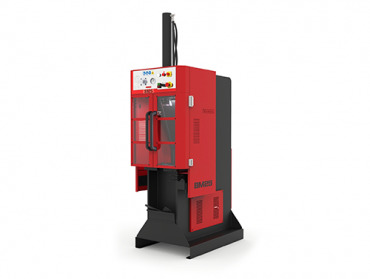
For the Nargesa BM25 broaching machine, the maximum stroke is 600 mm (23.62 inches), offering excellent capacity to work with small, medium, and large broaches up to 25 mm or 1 inch, allowing a wide range of applications for keyways, splines, hexagons, and other internal profiles.
What are the limitations of broaching?
Although vertical broaching is a highly precise, efficient, and repeatable process, it also has some technical limitations that should be considered when choosing the most suitable machining method.
Main limitation: inability to broach blind holes
One of the main limitations of vertical broaching is that it does not allow internal broaching in blind holes (i.e., non-through holes). This is because:
The broach needs to pass completely through the hole to finish cutting all the teeth of the tool.
If the hole has a bottom (is blind), the broach has no space to complete its stroke, so the desired profile cannot be achieved.
What is the difference between broaching and machining?
Although both broaching and conventional machining (CNC lathe, milling, etc.) are chip removal processes, there are fundamental differences in the mode of operation, the tool used, and process efficiency.
Broaching:
- Performed using a special tool called a broach, which has a series of stepped teeth designed to progressively cut the material.
- Thanks to this design, the broach removes chips in a controlled manner and leaves a precise, clean, and error-free finish, even on complex profiles such as keyways, splines, or internal shapes.
- Offers high dimensional accuracy and repeatability, ideal for series production.
- Does not require a complex machine; for example, the Nargesa BM25 broaching machine is easy to transport, does not require anchoring, and can be positioned near other production machines.
Machining (CNC lathe with broaching tool):
- Some broaching operations can be simulated on CNC lathes using linear broaching tools.
- Although convenient because the part comes out fully finished from the lathe, it has important limitations:
- Not recommended for slots or profiles larger than 5 mm, as the force on the turret can damage expensive components.
- High risk on high-value CNC machines.
Operational advantage of broaching with the BM25:
- Many workshops choose broaching on machines like the Nargesa BM25 because the same CNC lathe operator can perform broaching in parallel without stopping production.
- Thanks to its compact and portable chassis, the BM25 can be placed near the lathe, allowing dual operation without needing a second operator or fixed space.
- This significantly reduces operational costs, making the cost of broaching practically negligible.
- Preparation of the Nargesa broaching machine for a single-piece broach takes 60 seconds, unlike other machines where the process is much longer and more complex, making it very practical for unique parts or small series.
What are the most common industrial applications?
Broaching is widely used across multiple industrial sectors due to its precision, speed, and repeatability for machining complex internal or external profiles. The most common applications are in industries that require highly standardized components with tight tolerances.
Main sectors using broaching:
- Automotive:
- Manufacturing of gears, pinions, splined shafts, pulleys, and keyways.
- Ideal for both small and large volumes with precision requirements.
- Aerospace:
- Structural and transmission components with special internal profiles.
- High requirements for surface quality and tolerances.
- Industrial and agricultural machinery:
- Production of couplings, bushings, moving parts, and components with internal slots or splines.
- Use of specific broaches for large parts.
- Tool manufacturing:
- Broaching of handles, fitted bases, and adjustment mechanisms.
- Energy industry:
- Parts for turbines, electric motors, and mechanical transmission systems.
- Defense and railway:
- Manufacturing of precision elements subjected to high loads.
- Technical plastics and composites:
- Machining of plastic components requiring precise profiling, especially in molds or mechanical assemblies.
Advantages in these industries:
- Reduced cycle times.
- High dimensional accuracy without secondary operations.
- Possibility of integration into work cells alongside other machines such as lathes or CNC centers (e.g., Nargesa BM25 broaching machine).
Do they require anchoring or can they be used on a bench?
The Nargesa BM25 broaching machine does not require floor anchoring for operation, providing great operational flexibility. It is designed with a robust, self-supporting structure, which allows:
- Easy transportation using a forklift, pallet jack, or even an overhead crane.
- Temporary or permanent placement near other machines (such as lathes or CNC centers) without the need for fixed installation.
- Adaptation to different workshop configurations according to production needs.
The BM25 is not designed to be used on a bench, due to:
- Its dimensions and weight, which require a stable base.
- The force that the structure must withstand during the broaching process, especially when using broaches up to 25 mm (1 inch) in diameter.
- The need to maintain precise alignment and rigidity to ensure machining quality and avoid vibrations or deviations.
Therefore, although it is mobile and not fixed, it cannot be placed on a bench.