Frequently Asked Questions about Cold Forging Twisting Machines NARGESA
What types of twists does this machine allow?
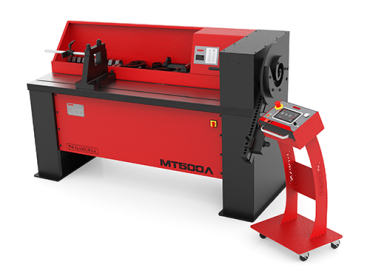
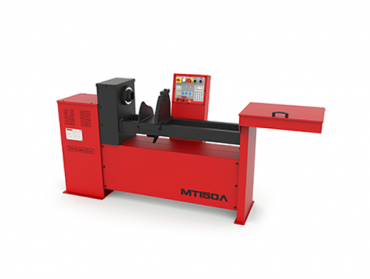
Both the MT150A and MT500A allow performing a wide variety of cold twists on metal profiles for ornamental forging, in a precise, fast, and repetitive manner.
Types of twists they perform:
- Full twist: Uniform rotation of the entire bar, ideal for bars, gates, or handrails.
- Partial twist: Only on a specific section of the piece. Very useful for decorative details.
- Twist + bend: Allows combining twists with curves, hooks, or scrolls on the same piece.
- Scrolls and spirals: With optional tooling, can make flat, edge, or oval scrolls.
- Custom twists: With the digital programmer, you can control angles, length, rotation direction, and number of pieces.
Both machines are perfect for producing standard parts and custom designs in artistic ironwork and decorative forging. The MT150A is ideal for small or medium workshops, and the MT500A for larger productions or more demanding jobs.
Which materials are suitable for working with the twisting machine?
The Nargesa MT150A and MT500A twisting machines are designed to work with cold metal materials, compatible with a wide variety of profiles and sections.
Suitable materials:
- Mild iron
- Carbon steel
- Aluminum
- Brass
- Bronze
- Stainless steel (moderate thickness)
- Malleable non-ferrous metals
Compatible shapes and profiles:
- Solid squares and rounds
- Tubes
- Strips and handrails
- Rebars
- Decorative or structural profiles
Important: always works cold, without heating the material, which reduces costs, time, and risks.
In summary, any ductile and consistent material that can deform without breaking can be processed with these machines.
Is the twist performed on profiles, solid bars, or tubes?
Yes, the Nargesa MT150A and MT500A are designed to work with a wide variety of metal sections, allowing precise twisting of solid bars, tubes, strips, and decorative profiles, always in cold working.
Types of materials that can be twisted:
-
Solid bars (square or round)
The most commonly used in ornamental forging. Thanks to their solidity, they allow very pronounced twists without structural deformation risk.
MT150A: up to 20 mm square
MT500A: up to 40 mm square
-
Tubes (round or square)
Can also be twisted if they have enough thickness to resist the stress without collapsing or wrinkling. Often used for lighter or decorative parts.
-
Strips and handrails (flat bars)
These flat sections allow combining twisting with bending, creating shapes like scrolls, spirals, or hooks.
MT150A: up to 35 × 10 mm
MT500A: up to 50 × 10 mm
-
Decorative or structural profiles
Some special geometry profiles can also be processed if compatible with tooling and have sufficient strength.
Technical considerations:
The material type (iron, steel, brass, aluminum, etc.) and its ductility directly influence the twist result.
Very thin tubes or thin-walled tubes are not recommended, as they can deform easily.
It is important to use the proper tooling according to profile type and desired design.
In summary, Nargesa twisting machines are versatile and allow twisting a wide variety of shapes and materials, ideal for both solid and hollow parts, as long as work is done within the capacity limits of each model.
Can custom twist patterns be programmed?
Yes, both the Nargesa MT150A and MT500A allow programming custom twist patterns thanks to their built-in digital control panel.
These machines are equipped with an electronic programmer that allows the operator to precisely define the parameters needed to repeat specific twists automatically and accurately.
Available programming functions:
- Custom twist angle (number of turns or fractions)
- Start and end point of twisting
- Rotation direction (right or left)
- Adjustable twist speed
- Piece quantity via built-in counter
- Memory for up to 8 different programs, to work with different designs without reprogramming from scratch
System advantages:
Allows creating unique or custom designs, highly valued by architects, designers, and end customers.
Improves productivity and repeatability in series of identical pieces.
Reduces errors and increases accuracy compared to manual work.
Ideal for series production or for reproducing exactly the same design in different orders.
In short, these twisting machines not only allow working with standard tooling but also provide the flexibility to create and save custom patterns, making the MT150A and MT500A very powerful tools for workshops seeking to stand out with exclusive parts or custom productions.
What accessories are included with the machine?
Both the MT150A and MT500A include a complete standard tooling kit that allows a wide range of ornamental operations: twisting, bending, scrolls, hooks, links, rings, and more. These accessories are made of F1140 tempered steel or tempered microfusion, designed to work cold with high precision and durability.
Included accessories:
-
Twisting dies for squares
Includes various die combinations to twist squares of different sizes.
In millimeters: 12, 14, 16, 18, 20, 25, 30, 35, and 40 mm
In inches: 1/4”, 3/8”, 1/2”, 5/8”, 3/4”, 1”, 1 1/4”, 1 1/2”, 1 3/4”
-
Twisting dies for strips or handrails
MT150A: up to 35×10 mm (1 1/4” x 3/8”)
MT500A: up to 50×10 mm (2” x 3/8”)
-
Bending dies (pin type)
For making hooks, links, or curved shapes.
Capacity up to 16 mm (MT150A) or 20 mm (MT500A) round or square.
On strips, up to 40 × 10 mm or 50 × 10 mm depending on the model.
-
Dies for rings with 80 mm inner diameter (3 1/8”)
Round or square up to 16 mm
-
Dies for scrolls and spirals (start and development)
Outer diameters: 80 mm, 100 mm, 120 mm, 180 mm, 220 mm, 450 mm
For materials up to 25 mm section or 50×10 mm on strips
-
Braiding die (MT150A only)
Allows braiding three round bars up to 8 mm in diameter simultaneously
These tools come standard included and allow the operator to make a wide variety of designs without additional purchases. For more specific shapes or finishes, Nargesa also offers optional accessories, such as “dove chest” dies, edge scrolls, fixed radius curves, decorative pinecones, and more.
What maximum diameter or section is allowed?
The Nargesa twisting machine allows different maximum diameters or sections depending on the model:
MT150A:
- Solid square: up to 20 mm (or 3/4”)
- Solid round: up to 16 mm (or 5/8”)
- Strip / handrail: up to 35 × 10 mm (or 1 1/4” × 3/8”)
- Maximum continuous twist length: 960 mm
MT500A:
- Solid square: up to 40 mm (or 1 3/4”)
- Solid round: up to 25 mm (or 1”)
- Strip / handrail: up to 50 × 10 mm (or 2” × 3/8”)
- Maximum continuous twist length: 1,620 mm
These capacities apply to cold working with conventional carbon steel. For harder materials, they may vary slightly depending on shape, tooling, and material resistance.
Can double or combined twists be performed?
Yes, with the automatic Nargesa MT150A and MT500A twisting machines, it is possible to perform double or combined twists, thanks to their robust design, versatile tooling, and programmable movements.
What types of twists can be combined?
- Symmetrical double twist: Two opposite twists at the ends of the same bar, common in decorative bars for gates or handrails
- Partial twist + bend: Only part of the bar is twisted and then bent in another section, ideal for hooks or links
- Twist + spiral or scroll: Twist one section and then transform the rest into a spiral or ornamental design
- Stepped twist: Apply different twist degrees to different sections of the same piece
How is it done?
Both models have two independent work zones (twisting and bending), allowing operations to alternate without disassembling the piece. With the digital programmer, start and end points for each operation can be set with full precision.
This customization is especially useful for unique pieces or small high-decor series, like in architecture, artistic furniture, or ornamental ironwork. For higher complexity, Nargesa also provides or manufactures custom tooling.
What is its use in artistic or decorative ironwork?
The automatic Nargesa twisting machine (models MT150A and MT500A) is key for artistic and decorative ironwork, transforming simple metal bars into elaborate ornamental pieces quickly, precisely, and repeatably.
Main uses in decorative ironwork:
- Twisted bars: Widely used in gates, balconies, doors, and handrails. Twists add volume, dynamism, and aesthetic value
- Scrolls and spirals: Classic elements for decorating doors, headboards, stairs, or metal furniture. Included dies allow various sizes and thicknesses
- Hooks, links, and decorative curves: Ideal for handrails, lamps, tables, chairs, or other curved/interconnected elements
- Ornamental rings: Used between bars or as finishing touches
- Custom and unique designs: With interchangeable tooling and the ability to create molds, blacksmiths can make unique pieces for architecture, restoration, or modern design
- Artistic furniture and design structures: Used for artistic wrought iron furniture, decorative structures, dividers, lattices, and garden/exterior elements
In short, these twisting machines save time in craft production and allow adding an artistic and distinctive touch, increasing the final value of ironwork projects.
Is prior experience required to operate it?
No, prior experience is not required to operate the Nargesa twisting machine, as it is designed for ease of use for both skilled operators and beginners.
- Intuitive control panel: Digital display, touch keyboard, piece counter, simple programming. Easily set start and end points of twisting or bending
- Automatic programmer (MT150A and MT500A): Save up to 8 memories, repeating designs without recalibration
- Quick tooling change: Accessories mount/dismount easily, no complex tools or adjustments
- Safety and reliability: Electrical protection, automatic unlock, and easy-access controls
- Fully assembled machine: Delivered ready to use, no special installation or extended training required
Although experience is not essential, as with any industrial equipment, a brief initial training (provided by Nargesa or distributors) is recommended to fully utilize the machine safely. Many workshops start using it after just a few minutes of training.